Introduction
Tides is an application that allows users to navigate the world by understanding the ebb and flow of energy in their lives.
Reality
Problem Statement
Current navigation apps focus on speed and efficiency, failing to account for the difficulties faced by people with disabilities, chronic fatigue, or burnout. As a result, even trips in ‘accessible’ spaces can be exhausting, limiting mobility and independence
Research Methods
To better understand the needs and challenges faced by our target users, we dove deep into researching prominent challenges and existing pathfinders.
Current Accessibility Gap
The key gap in mainstream navigation is the lack of support for personal energy constraints. To some, fatigue is not simply tiredness, and can be a disabling symptom that limits mobility and requires energy budgeting.
Current navigation apps with accessibility inclusions are usually targeted towards mobility disabilities, and don't consider other disabilities. [1]
Current Route-Finding Gap
- Steep inclines and elevation gain
- Stairs and lack of elevators
- Narrow or uneven pathways
- Construction obstacles and pathway closures
- Crowded or noisy environment
User Findings
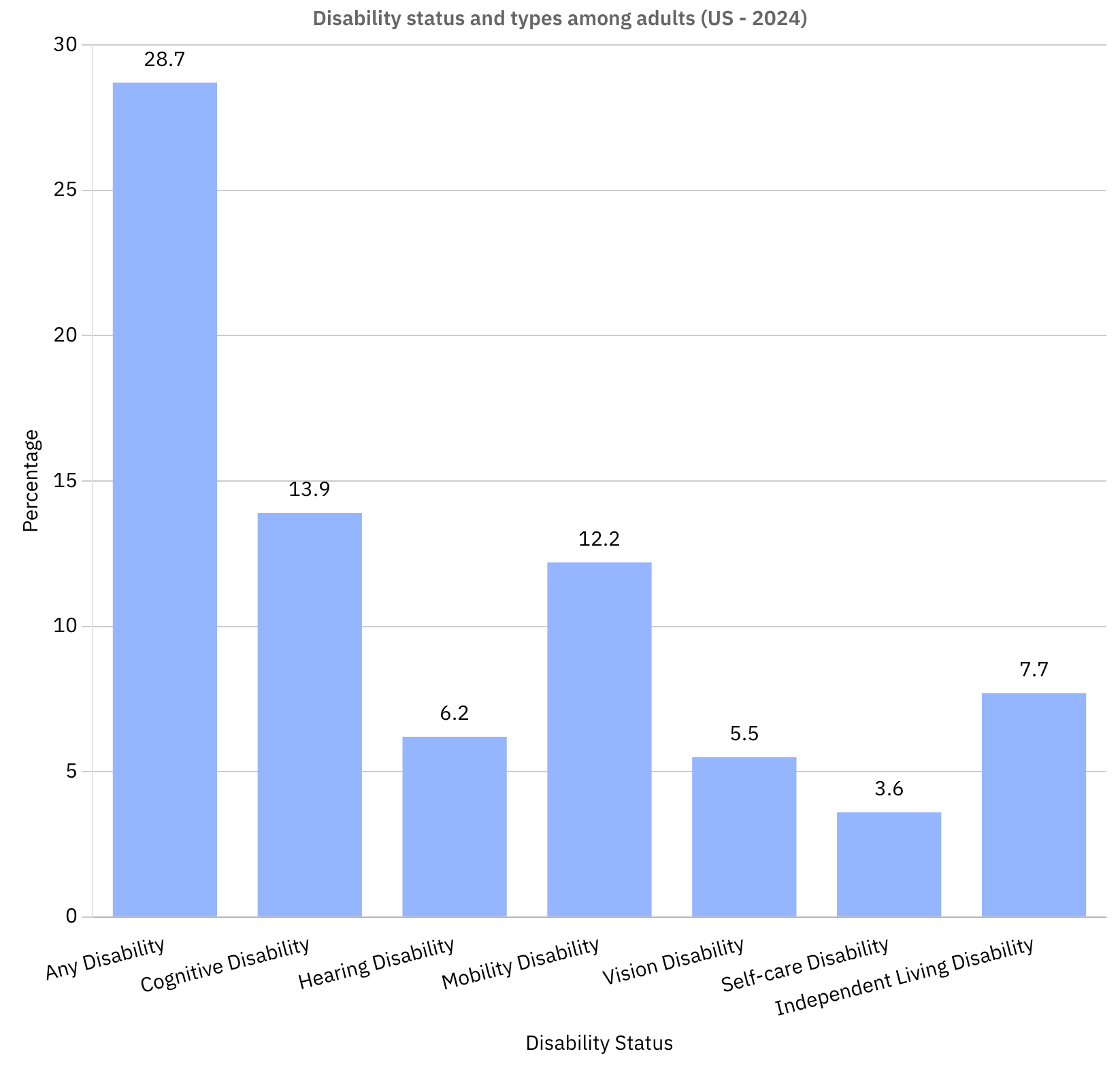
According to the CDC Disability and Health Data System, in 2024 approximately 28.7% of the United State's population (~9.8 million people) has a disability. This highlights the scale of the population potentially impacted by barriers in infrastructure. [3]
People with disabilities (mobility, cognitive, sensory) have different travel patterns, such as having 10%-30% fewer non-work trips and slower modes for short distances.
Environmental, social, and systemic barriers increase travel time, reduce trip frequency, and limit access to certain transportation modes. Failing to consider people with disabilities in transportation planning leads to inaccurate predictions, poor infrastructure decisions, and transportation-related injustice. [1]
Prior research has shown that individuals with mobility limitations or chronic fatigue face increased difficulty with navigation, and there is a strong correlation between fatigue and disabilities, including mental illness. [2]
Participants reported willingness to take longer routes, both in distance and time, to avoid barriers like stairs, carpet, or noisy areas.
Many participants experience multiple disabilities (especially older adults), not just mobility limitations.
Motivation
Mobility is a foundation for independence, inclusion, and quality of life. Current navigation systems assume all users have the same physical capacity and mental readiness, however, millions of people live with limited daily energy, chronic fatigue, and accessibility constraints that make travel more difficult than just walking from point A to point B. Ultimately, our goal is to empower disabled users with greater control over how they move through their communities by supporting saver travel, increased participation, and more equitable access to public spaces by providing accessible, tailored navigation.
Prototype Design
Based on our research findings, we developed a prototype that addresses the identified challenges. The prototype includes features such as energy tracking, personalized recommendations, and community support.
Design Decisions
Our design decisions were guided by our core goal: creating an accessible, energy-aware navigation tool that supports users with physical and mental health disabilities. Because many users may experience fatigue, sensory overload, or mobility limitations, we prioritized clarity, familiarity, and personalization throughout the interface.
Battery percentage as an energy indicator:
We represent the user’s current energy level using a battery-style percentage. This is a familiar symbol that most users immediately understand, making it an intuitive way to communicate “remaining energy” without requiring additional explanation.
Color palette inspired by our theme of tides:
We chose blue as our primary color to match our app’s identity and name. The ocean and tides represent how energy naturally “ebbs and flows,” reflecting the dynamic and changing energy levels that many disabled and chronically ill individuals experience throughout the day.
Personalized route decision-making:
Our routing algorithm is designed to adapt to a user’s energy state, disability-related needs, and environmental preferences (such as avoiding stairs, steep elevation, or crowded areas). Importantly, users can always override recommendations to maintain autonomy and control over their experience.
Simple, readable, and accessible interface:
We intentionally used large buttons, clear icons, high color contrast, and minimal text to ensure the app remains readable and easy to navigate for a wide range of users. Keeping the interface uncluttered helps reduce cognitive load and prevents users from feeling overwhelmed.
Algorithm Overview
- We determine starting body battery based on user's health data, which can be adjusted manually.
- As users navigate through their day, their body battery depletes based on exertion or increases during rest periods.
- When navigating, paths are pulled up based on energy consumption, time, and distance. This allows users to weigh each factor of their trip.
Future Work
Integrations
Health Data
Integrating health data from wearable devices to provide a baseline for energy levels. Some fields could include:
- Average daily step count: Depending on how far you usually walk, the amount of energy points per distance will vary.
- Sleep data: The more well rested you are the higher your starting energy levels will be.

Chatbot
With responses facilliated by an AI agent and using location data:
- Real-time assistance when encountering issues with routes.
- Reporting accessibilty barriers such as a lack of ramps, stairs, etc.
References
Made By
Ruslana Korolov


Hanna Pan

Alice Zhu

Nicole Ham